Architecture Is Not Enough Anymore

Why we rebuilt how we practice and why it matters for every project we touch.


Something changed in the residential development market, and most architecture firms have not caught up.

Interest rates doubled. Construction costs surged. Affordable housing thresholds in Boston shifted, eliminating entire project types almost overnight. Across the region, a quiet epidemic emerged. Projects with full ZBA approval, years of community process behind them, and stamped drawings ready to go had no path to financial viability.

Shovel ready. Economically dead.

When developers began asking us to take a second look at these stranded approvals, the pattern was always the same. The design had often been thoughtful, technically competent, sometimes even beautiful. But it had been developed in isolation from the realities that ultimately determine whether a project gets built.

Nobody had run the numbers as the design evolved. Nobody had stress tested the pro forma against real construction costs. Nobody had asked the hardest question early enough. Does this actually pencil?

We had the tools to answer that question. And we realized those tools were not an advantage. They were the foundation.


The Gap Nobody Talks About

Traditional architectural practice is built on a handoff model. The architect designs. The contractor prices. The developer evaluates feasibility. Each discipline contributes its piece and passes the project down the line.

In a forgiving market, low interest rates, rising rents, and abundant capital, this approach works. Inefficiencies are absorbed. Value engineering happens late. A few costs are trimmed, and the project still moves forward.

That market is gone.

Today, the line between a built project and a stranded approval is razor thin. A unit mix misaligned with the market. Amenities that add cost without increasing revenue. Circulation and common areas that erode net rentable area. These are not design details. They are economic drivers. In this environment, they often determine whether financing is even possible.

And yet the professional norms of architecture still treat cost and financial modeling as someone else’s responsibility. Something that happens later. Something the architect addresses only after the owner returns with a list of cuts.

By then, the leverage of design has already been lost.

What We Mean by Integrated

We use the word integrated carefully because it has been diluted to the point of meaninglessness. Every firm claims collaboration. Every proposal references coordination. What we mean is specific.

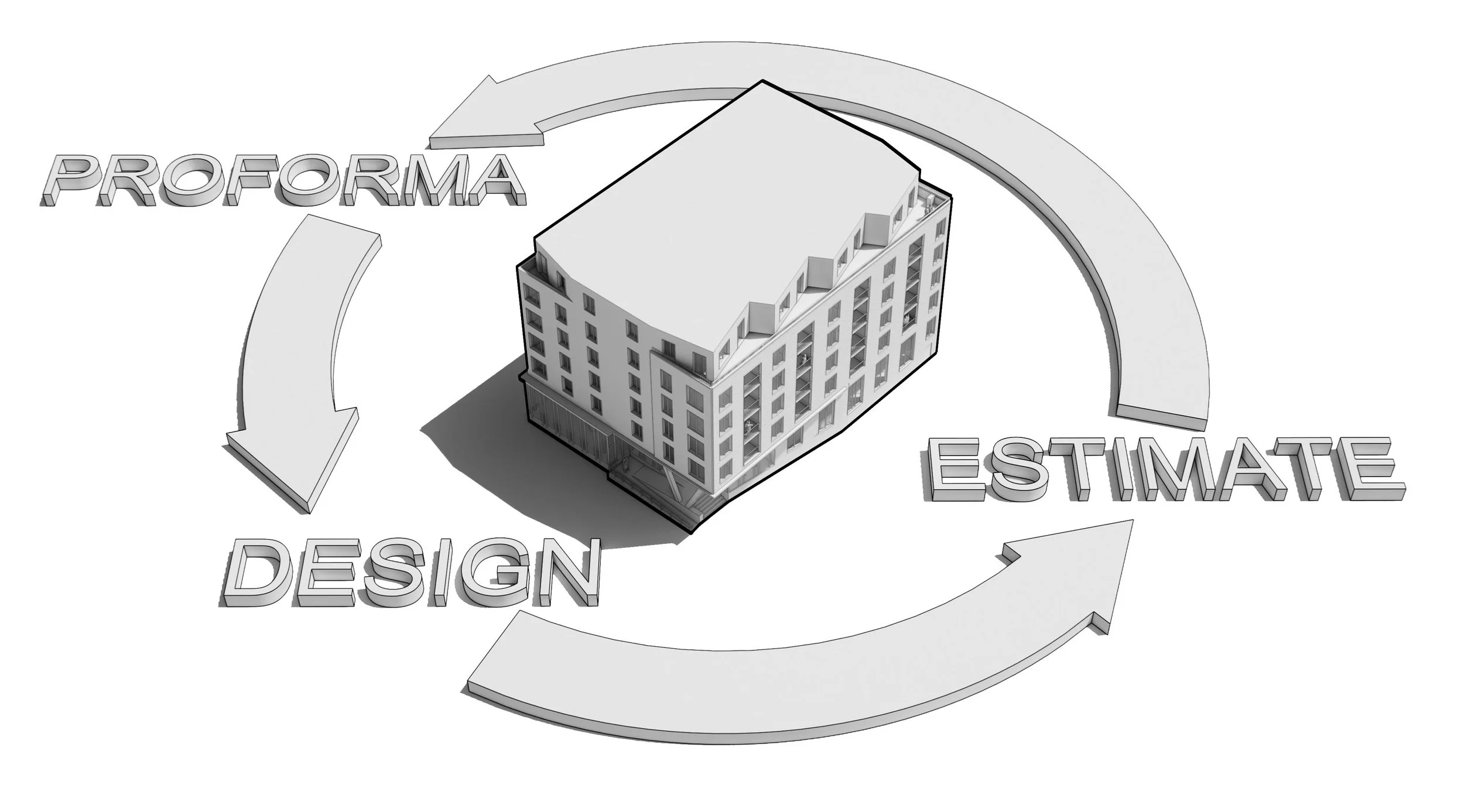
From the first sketch of any project, three forces are on the table at the same time. Design, construction cost, and financial performance.

Not as separate documents reviewed at milestones. Not as checkpoints at the end of schematic design. As a continuous feedback loop in which design informs cost, cost reshapes the pro forma, and the pro forma reshapes design. This process is repeated rapidly until the project finds a viable form.

This approach stands on three legs.

First, residential expertise.
We bring more than two decades of experience in the Boston and New England multifamily market. Our team has designed thousands of units across dozens of buildings, from small infill developments to large communities for institutional owners and mission driven organizations. This depth of experience allows us to understand product positioning, renter behavior, and regional construction realities at a granular level. We know what actually rents, what drives absorption, and how subtle design decisions affect long term performance. We are not operating as outside advisors. We are practitioners grounded in the specific demands of this market.

Second, cost estimating.
We have the in house capability to price residential projects in real time. We do not send drawings out and wait for a number to come back. Instead, we work directly with our construction partners to solve problems as they emerge. This allows us to test decisions immediately and understand not only what something costs, but how to design it so the cost works from the very first sketch.

Third, financial performance.
We understand how square footage allocation translates into NOI. We know how a decision made at the beginning of a project, such as the structural grid, the depth of the building, or the configuration of the corridor, will echo through the pro forma years later. This gives us the ability to align design choices with real underwriting and current market conditions rather than abstract assumptions.

Because these three legs operate together, design is no longer a linear process. It becomes a tool for aligning vision, feasibility, and execution from the start.

Sustainability enters that same loop from the beginning. With deep experience in passive house and high performance envelopes, we treat energy and carbon as variables that improve long term building performance, not as upgrades added after the fact and removed when budgets tighten.

Why This Matters Now

The conditions that allowed residential development to coast on good design alone are not coming back.

Interest rates may ease. Construction inflation may moderate. But the structural pressures, affordability requirements, community process, climate standards, the sheer scarcity of viable sites in dense urban environments, those are permanent features of the landscape we're working in. If anything, they intensify.

The next decade of housing production in Boston and across New England will be defined by projects that find the narrow path to viability, projects where design excellence and financial discipline aren't in tension, but are the same thing. Where a better building is also a more buildable one. Where the architect's creative instincts and the developer's financial reality aren't adversaries, but partners working the same problem from the start.


Architecture is not enough anymore. It never was, really, the market just made it easy to pretend otherwise.

We stopped pretending. And we built a practice around what it actually takes to get things built.

About the Author

Catriel Tulian, AIA, NOMA, LEED AP is a principal at Stack Architecture, a Boston-based architecture practice specializing in multifamily and mixed-use residential development across New England.

With more than 20 years of experience, Catriel works closely with developers to align design, construction cost, and project feasibility from the earliest stages of development.

Next
Next

Good design doesn’t always cost more. But it always earns more.